Methodology
Transparent by design. Auditable by default.
Every emission factor we use is published and citable. Every calculation is traceable to a source. There are no proprietary multipliers in Carbonkindle.
Standards foundation
Structured around the GHG Protocol Corporate Standard.
The GHG Protocol Corporate Accounting and Reporting Standard is the globally recognized framework for corporate greenhouse gas inventories. Carbonkindle is designed for alignment with its Scope 1, 2, and 3 methodology.
GHG Protocol alignment
Carbonkindle is designed for alignment with the GHG Protocol Corporate Accounting and Reporting Standard (2004, revised) and the Scope 2 Guidance (2015) and Corporate Value Chain (Scope 3) Standard (2011). We do not claim GHG Protocol certification — the Protocol is a framework, not an audit regime.
CSRD ESRS E1 mapping
The Carbonkindle report builder is structured to support reporting under the European Sustainability Reporting Standards ESRS E1 (Climate change). Our disclosure templates reference the relevant ESRS E1 disclosure requirements for GHG emissions, targets, and transition plans.
Emission factors
Where the numbers come from.
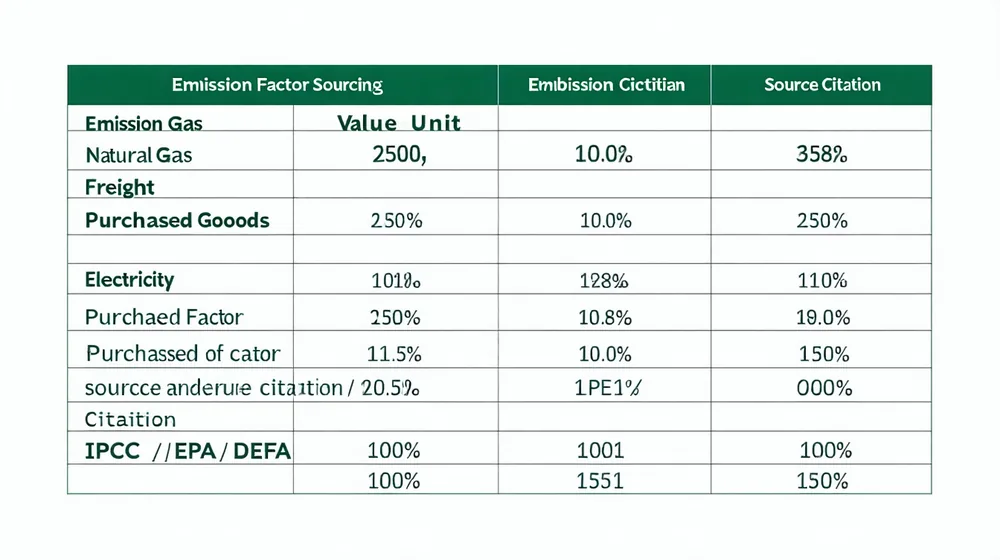
Emission factors are the coefficients that convert activity data (kWh of electricity, litres of fuel, tonne-km of freight) into CO₂e. Every factor in Carbonkindle is traceable to a specific publication and version.
Note: Carbonkindle is not affiliated with or certified by IPCC, EPA, or DEFRA. These are publicly published databases we draw from to build our emission factor library.
Scope 3 coverage
All 15 categories. Status transparent.
Scope 3 is where most corporate footprints live and where most accounting platforms cut corners. We show exactly which categories are automated and which require manual input.
| Category | Description | Method | Status |
|---|---|---|---|
| Cat 1 | Purchased goods and services | Spend-based (Ecoinvent) | Automated |
| Cat 2 | Capital goods | Spend-based | Automated |
| Cat 3 | Fuel and energy-related activities | Activity-based (EPA/DEFRA) | Automated |
| Cat 4 | Upstream transportation and distribution | Activity-based (DEFRA) | Automated |
| Cat 5 | Waste generated in operations | Activity-based | Automated |
| Cat 6 | Business travel | Activity-based (DEFRA) | Automated |
| Cat 7 | Employee commuting | Survey + activity-based | Manual input |
| Cat 8 | Upstream leased assets | Asset-based | Manual input |
| Cat 9 | Downstream transportation and distribution | Activity-based (DEFRA) | Automated |
| Cat 10 | Processing of sold products | Activity-based | Manual input |
| Cat 11 | Use of sold products | Activity-based | Manual input |
| Cat 12 | End-of-life treatment of sold products | Spend/activity-based | Automated |
| Cat 13 | Downstream leased assets | Asset-based | Manual input |
| Cat 14 | Franchises | Franchisor method | Manual input |
| Cat 15 | Investments | Investment-specific | Manual input |
Manual input categories require user-supplied activity data. Carbonkindle provides structured data templates and factor lookup for each.
CSRD mapping
ESRS E1 requirements cross-referenced.
CSRD requires disclosures under European Sustainability Reporting Standards. Here is how Carbonkindle supports the climate-related ESRS E1 requirements.
ESRS E1-1
Transition plan
Target-tracking module supports disclosure of emission reduction targets linked to GHG inventory data.
ESRS E1-6
Gross Scope 1, 2, 3 GHG emissions
Fully populated from the Carbonkindle inventory. Disaggregated by scope and category.
ESRS E1-7
GHG removals and GHG mitigation projects
Separation of offset purchases from operational inventory is enforced by design — no greenwashing conflation.
ESRS E1-9
Financial effects of climate risks
Climate financial impact module for transition and physical risk disclosure. Supports double materiality assessment workflow.
Questions about our methodology?
Talk to Annika directly. She reviews every methodology question personally.