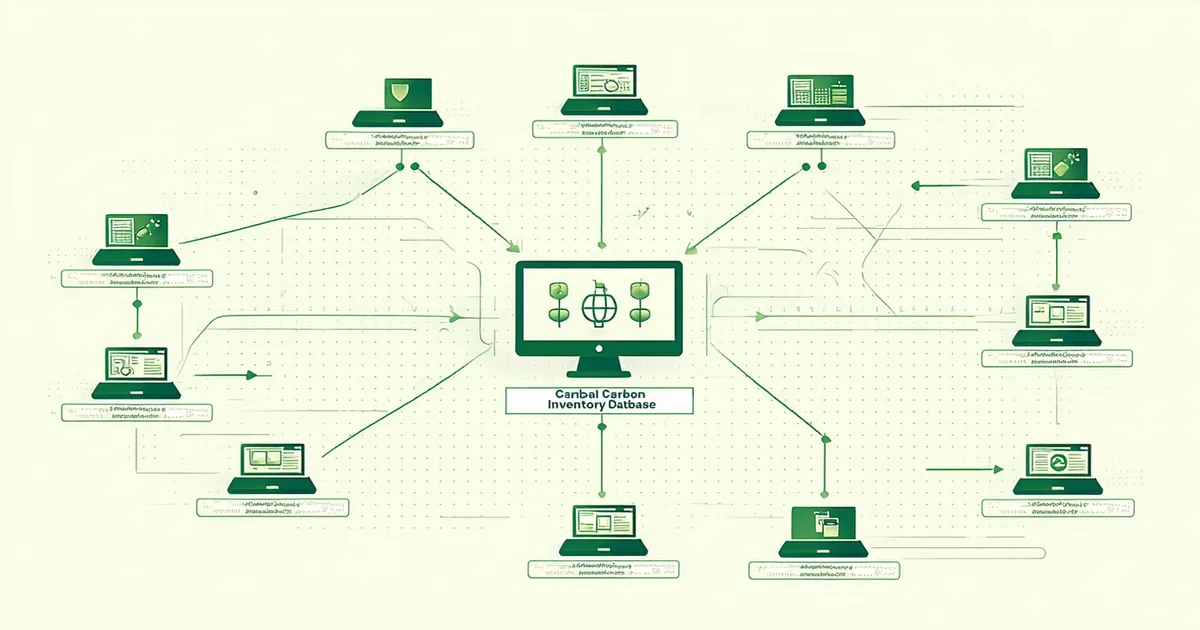
Supplier data collection is the hardest operational problem in most corporate GHG inventories. The difficulty is not conceptual — the GHG Protocol Scope 3 Calculation Guidance describes three calculation methods per category with increasing data quality from spend-based to supplier-specific. The difficulty is organizational: getting hundreds of suppliers to report emissions data that most of them do not currently track, in a format that matches your calculation methodology, on a timeline that aligns with your reporting calendar. This article covers the approaches that reduce friction in that process, with particular focus on Category 1 (purchased goods and services) and Category 4 (upstream transportation and distribution), the two categories where supplier data quality most directly affects inventory accuracy.
Start with Spend-Based, But Plan Your Migration Path
The spend-based method — applying economic input-output emission factors to purchase spend data — is the standard starting point for Category 1 because it requires no supplier engagement. You need your accounts payable data and an emission factor database (USEEIO or Ecoinvent economic input-output extensions). The GHG Protocol explicitly endorses spend-based as an interim method while supplier-specific data collection programs are developed.
The problem with staying entirely spend-based for more than one or two reporting cycles is that it produces low-accuracy estimates — error ranges of ±50–100% per spend category are common for economic input-output factors — and it does not satisfy the data quality improvement expectations in ESRS E1 for CSRD reporters. More practically, a spend-based Category 1 figure for a manufacturer purchasing hundreds of tonnes of machined steel will be significantly less accurate than an activity-based figure using a mass-based emission factor from Ecoinvent 3.10 for the specific steel type. Planning the migration path from spend-based to activity-based or supplier-specific means identifying, in year one, which spend categories are large enough that improving the data will materially change the Category 1 total.
A practical segmentation: sort your Category 1 suppliers by annual spend. The top 10–20 suppliers that together represent 50–70% of total procurement spend are the priority target for data quality improvement. Everything else can stay spend-based indefinitely without materially distorting the overall Category 1 figure.
Structuring a Supplier Emission Data Request
The most common mistake in supplier engagement is asking too broadly. A request to "provide your carbon footprint" gives a supplier no guidance on boundary, methodology, or format, and generates responses — when any come — that range from Scope 1-only figures to full CDP Climate questionnaire submissions. Neither is necessarily useful without interpretation.
An effective supplier data request template for Category 1 includes: the specific product categories purchased from that supplier in the reference year; the requested metric (typically kg CO₂e per kg of product, or kg CO₂e per unit); the preferred calculation methodology (GHG Protocol Product Standard or equivalent); the emission factor sources that are acceptable (Ecoinvent, DEFRA, national databases); and the reporting boundary (cradle-to-gate for the specific product, not the supplier's full organizational footprint). The narrower and more specific the request, the higher the response quality and rate.
For large suppliers, a structured template in spreadsheet format with dropdown-coded methodology fields reduces the manual review burden on your side and makes it clear you intend to use the data in a formal inventory. CDP's supply chain program uses this approach at scale — the CDP supply chain questionnaire sections on Scope 1 and 2 reporting and on Scope 3 Category 11 (use of sold products, from the supplier's perspective) are a reasonable model for a bilateral data request even outside the CDP program.
The Response Rate Reality
Realistically, a first-year supplier engagement program targeting mid-market tier-1 suppliers will achieve response rates of 20–40% without executive-level commercial pressure. This is not a failure — it is the baseline. Companies further along in their supplier engagement report improvement to 60–80% response rates after two to three years of consistent annual requests with supplier education, technical support, and — critically — signals that emissions performance will factor into procurement decisions.
We're not saying you should hold procurement decisions hostage to emissions data quality — that's disproportionate for a first reporting cycle and likely to damage supplier relationships. What does work is framing supplier engagement as a commercial partnership signal: communicating that your CSRD obligations will require you to report on value chain emissions annually, that supplier-specific data improves the accuracy of those reports (and therefore reduces the risk of overstated estimates that reflect poorly on the supplier), and that you are offering technical support for suppliers who have not yet measured their footprint.
Category 4: Upstream Transportation Data
Category 4 covers third-party freight emissions for inbound logistics — goods transported from suppliers to your facilities. The calculation method under GLEC Framework v3 is: shipment weight (tonnes) × distance (km) × modal emission intensity (kg CO₂e per tonne-km). The challenge is assembling the activity data: weight, distance, and mode for every significant inbound shipment in the reporting year.
For companies using 3PLs (third-party logistics providers), the most efficient path is requesting a carbon report directly from the logistics provider. Many major freight forwarders — as well as regional road carriers — now produce emission reports using GLEC Framework methodology as a standard client deliverable. The report quality varies considerably, so verifying that the provider's methodology documentation is available and references recognized emission intensity values is worth the effort before using their figures in your inventory.
For direct imports where the freight is managed by the supplier rather than by you, the data request to the supplier should include shipping mode, origin port, destination port, and shipment weight. This gives you the inputs to calculate Category 4 emissions yourself using GLEC default values even if the supplier does not provide a calculated figure.
Building a Supplier Data Portal vs. Email-Based Collection
For companies with more than 50 priority suppliers, email-based data collection quickly becomes unmanageable. Responses arrive in inconsistent formats, version control is unclear, and matching returned data to the original request template requires significant manual effort. A structured supplier portal — even a simple one built on a shared form platform — creates a single submission workflow with defined fields, validation rules, and a timestamped audit trail of what was submitted and when.
Consider the operational scenario at Halsten Manufacturing NA, a US subsidiary of a European industrial group with CSRD obligations: their sustainability team managed Category 1 data collection for 38 North American suppliers via email for their first inventory year. Between out-of-date contacts, format inconsistencies, and multiple rounds of clarifying exchanges, the data collection process consumed the equivalent of roughly four weeks of analyst time. In year two, moving to a form-based submission workflow with a built-in methodology guidance document reduced that to approximately one week, with a 15-point improvement in first-submission data quality.
When Suppliers Can't or Won't Provide Data
Not all suppliers will provide data, and some who respond will provide data of insufficient quality to use directly. The GHG Protocol's Scope 3 standard provides a hierarchy for handling this: use supplier-specific data where available; use industry-average data (activity-based factors from Ecoinvent or similar databases) for categories where physical volume is known; use spend-based proxies where only financial data is available; and document all substitutions and their rationale.
This documentation is what protects you in assurance. A well-maintained data collection log that shows, for each major spend category, what was requested, what was received, and what substitution was applied when the response was unusable — that log is what an ISAE 3410 assurance provider uses to verify that the Category 1 figure is a reasonable estimate rather than a guess. The figure itself need not be perfect. The methodology documentation needs to be complete.