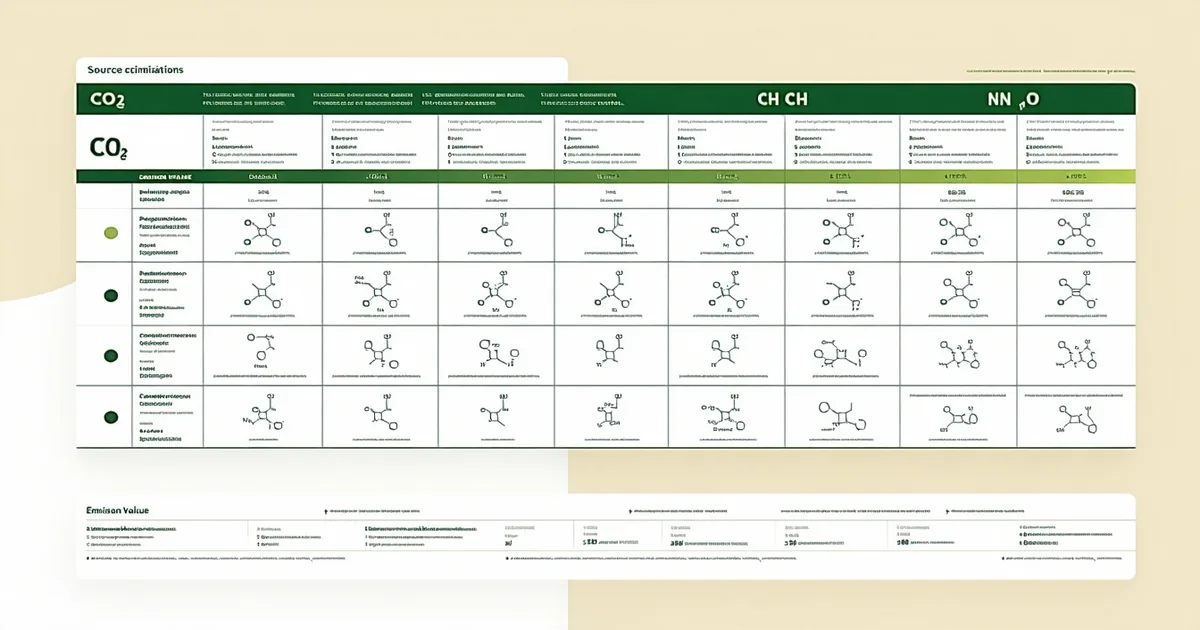
Every GHG inventory rests on emission factors: the coefficients that convert a measured physical activity — kilowatt-hours of electricity consumed, liters of diesel burned, tonnes of goods purchased — into a mass of greenhouse gases expressed in CO₂e. Most sustainability reports cite "emission factors from recognized sources" without explaining what that means methodologically or why the specific choice of factor can meaningfully change the resulting figures. This matters for audit readiness, and it matters for understanding the actual uncertainty in your inventory.
What an Emission Factor Is, Mechanically
An emission factor is a mean value — typically expressed as kg CO₂e per unit of activity — derived from empirical measurement studies, national energy statistics, or life cycle assessment databases. For a simple example: natural gas combustion in a stationary boiler has an IPCC Tier 1 emission factor of approximately 56.1 kg CO₂ per GJ of energy content (lower heating value), with additional CH₄ and N₂O components. When you multiply that by the volume of gas consumed (converted to energy units), you get the Scope 1 emission for that boiler.
The GWP100 (100-year global warming potential) values used to convert non-CO₂ gases to CO₂e equivalents matter here. The GHG Protocol currently recommends using IPCC AR5 values for consistency with prior reporting unless a company is transitioning to AR6. ESRS E1 and the updated GHG Protocol revision process are moving toward AR6 GWP100 values: CH₄ = 27.9 (up from AR4's 25 and AR5's 28), N₂O = 273 (up from AR5's 265). The difference is not trivial for companies with significant refrigerant or agriculture-related emissions. A company switching from AR5 to AR6 GWP100 values needs to restate its base year using the new values to maintain comparability — that restatement should be documented and disclosed.
Source Databases: What We Use and Why
Different databases serve different measurement contexts. Understanding which source applies to which emission category prevents the common error of applying a wrong-context factor — for instance, using a UK grid emission factor for a US facility's electricity.
EPA eGRID (US Grid Electricity)
The EPA Emissions and Generation Resource Integrated Database provides subregion-level emission factors for US electricity generation. The most recent release, eGRID2023, covers 26 subregions with separate annual average factors for CO₂, CH₄, and N₂O. For location-based Scope 2 accounting in the US, eGRID subregion factors are the standard. A facility in the WECC California subregion (CAMX) will have a substantially lower grid emission factor than a facility in the coal-heavy RFC East (RFCE) subregion — the difference can exceed a factor of four. Using a national average factor instead of the relevant subregion factor is a common methodological error in first-year inventories.
DEFRA (UK and International Conversion Factors)
The UK Department for Environment, Food and Rural Affairs publishes annual greenhouse gas conversion factors for company reporting. The DEFRA 2024 dataset covers UK grid electricity, transmission and distribution losses, transport modes (air, road, sea, rail), business travel, hotel stays, water, waste treatment, and materials. DEFRA factors are widely used outside the UK as proxies for European transport and materials contexts when country-specific data is unavailable, and are explicitly referenced in the GHG Protocol's Scope 3 Calculation Guidance for several category calculations.
Ecoinvent 3.10 (Life Cycle Inventory Database)
Ecoinvent is a comprehensive life cycle inventory database maintained by the Swiss Centre for Life Cycle Inventories. Version 3.10, released in 2023, contains over 20,000 datasets for materials, processes, energy carriers, and transport across multiple geographies. For Scope 3 Category 1 (purchased goods and services), Ecoinvent provides activity-based emission factors that are more precise than spend-based proxies for companies that know the physical volume and type of goods purchased. For example, using an Ecoinvent factor for primary aluminum production (approximately 12–16 kg CO₂e per kg, depending on energy mix) is more accurate than applying a generic "fabricated metals" spend factor.
IEA Energy Statistics (International Grid Electricity)
For companies with operations or supply chains in countries outside the US and UK, the International Energy Agency publishes electricity emission factors by country, updated annually. The IEA emission factors are suitable for location-based Scope 2 calculations in non-US, non-UK jurisdictions. Note that IEA figures represent annual average generation mix — they do not reflect regional variation within a country. For countries with highly heterogeneous grids (China, India), national averages may misrepresent the emission intensity of a specific facility's actual grid connection.
GLEC Framework v3 (Freight Transport)
The Global Logistics Emissions Council Framework, now in its third version, provides mode-specific emission intensity values for freight transport. GLEC v3 is the primary source for Scope 3 Categories 4 (upstream transportation) and 9 (downstream transportation and distribution). It covers road (by vehicle type and load factor), sea freight (by vessel type and route), air freight (by distance band), and rail — with both default values and a methodology for using carrier-reported data when available. The Smart Freight Centre's GLEC Tool implements the framework and is commonly used for logistics carbon footprinting.
Why Factor Choice Affects Audit Readiness
Emission factor choice is not neutral — it directly determines the magnitude of your reported footprint and, in some cases, whether your Scope 2 market-based figure can be validated. An external assurance provider conducting limited assurance under ISAE 3410 will assess whether the factors used are appropriate for the activity type and geographic context, and whether they are from a recognized, publicly available source with a documented version date.
Consider a scenario: a mid-size manufacturer with US and German operations uses US EPA factors for both the US and German facilities. The German facility's Scope 2 location-based emission factor should come from the IEA's Germany figure (or the ENTSO-E annual average for European context) — not from a US eGRID region. This cross-contamination of factors doesn't produce obviously wrong-looking numbers, but it will surface during assurance when the auditor checks factor sourcing against facility geography. The correction could meaningfully change the Scope 2 total, requiring a restatement and a note in the sustainability statement.
We're not saying minor factor version discrepancies are material misstatements — context matters, and assurance providers make proportionality judgments. But the documentation of which factor was used, from which source, at which version, applied to which activity category, is the minimum requirement for an auditable inventory. Without that documentation, an assurance provider cannot confirm completeness or accuracy.
Uncertainty and How to Represent It
All emission factors carry inherent uncertainty — a coefficient derived from a sample of process measurements will have a confidence interval that is rarely communicated in company sustainability reports. The GHG Protocol acknowledges this and does not require quantitative uncertainty analysis for most company inventories, but it does recommend that companies understand the relative uncertainty of different calculation approaches.
A rule of thumb from life cycle assessment practice: supplier-specific factors (measured at source) have the lowest uncertainty (typically ±5–15%); activity-based factors from high-quality databases like Ecoinvent are in the ±20–30% range; spend-based factors using economic input-output models carry uncertainty of ±50–100% for individual categories. This doesn't invalidate spend-based methods for early-stage inventories — the GHG Protocol endorses them as a starting point — but it does mean that a Scope 3 Category 1 figure calculated entirely on spend-based proxies should be disclosed as carrying higher uncertainty, with a plan to improve data quality over successive reporting cycles.
Keeping a versioned record of factor choices — which release of eGRID, which year of DEFRA, which Ecoinvent version — matters not just for current-year assurance but for base year comparability. If DEFRA 2024 values differ from DEFRA 2022 by more than 5% for a material category, you need to decide whether to restate the base year using current factors or document the choice to retain original factors. Either approach is defensible; an undocumented approach is not.