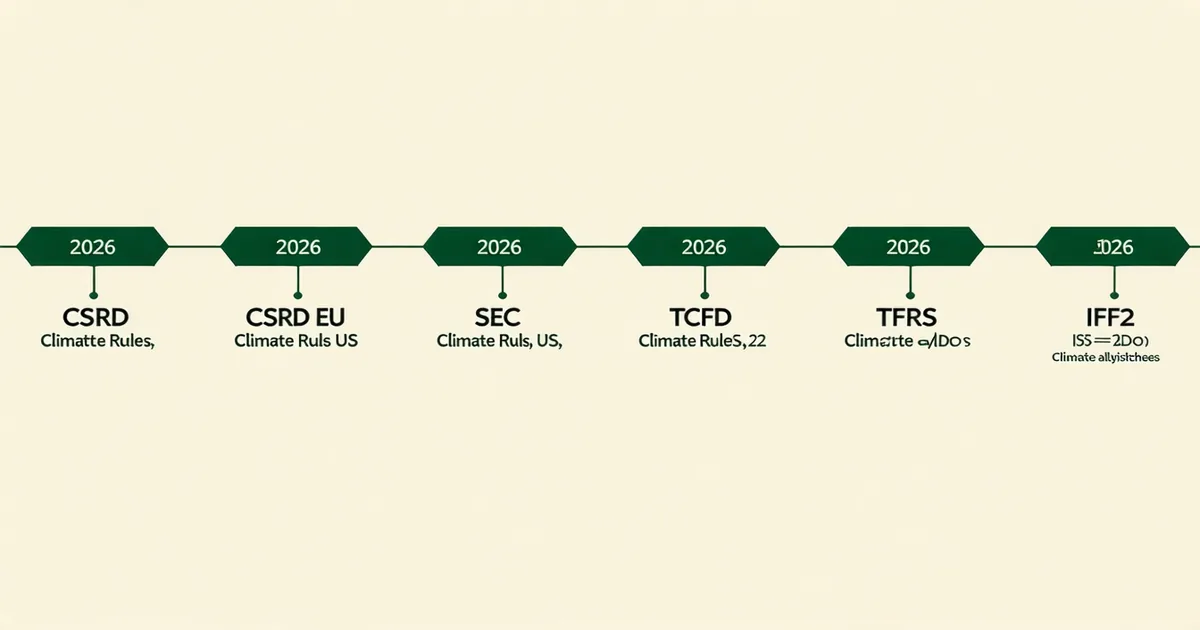
The regulatory architecture for carbon accounting and climate disclosure has changed more in the past eighteen months than in the preceding decade. CSRD enforcement has moved from implementation deadline to active reporting obligation for the first wave of reporters. The SEC's climate disclosure rules have navigated a complex legal path that has reshaped what US public companies must disclose. TCFD as a standalone framework has been formally absorbed into IFRS S2, creating a new jurisdictional competition between the ISSB standards and ESRS. For sustainability managers and finance teams managing disclosure obligations in 2026, understanding which frameworks apply to which entities — and where they overlap versus diverge — is the immediate practical challenge.
CSRD: Enforcement Is Real, and Wave Two Has Arrived
The first CSRD-obligated reports — from large EU companies previously subject to the Non-Financial Reporting Directive — covered financial year 2024 and were published in spring 2025. The most significant technical learning from that first wave: Scope 3 data quality was the most common source of qualified findings in limited assurance reports. Companies that had built Category 1 (purchased goods and services) on entirely spend-based proxies without any supplier engagement program were flagged not for the estimates themselves — which the standard permits in early years — but for the absence of a documented plan to improve data quality over future reporting cycles.
Wave two of CSRD — large EU companies not previously subject to NFRD — covers financial year 2025, with first reports due in 2026. This wave captures a considerably larger population of companies, including EU subsidiaries of US multinationals that were not previously subject to NFRD but meet the updated large-entity thresholds. For finance and sustainability teams at US companies with EU operations who have not yet begun their CSRD readiness work, the reporting timeline is no longer theoretical.
The European Financial Reporting Advisory Group has also published final guidance on the interplay between ESRS and the Taxonomy Regulation's alignment criteria — an important clarification for companies that report both a sustainability statement under CSRD and a Green Taxonomy disclosure under the EU Taxonomy Regulation. The two are not always consistent in how they define climate transition activities, and the reconciliation requires careful attention to which disclosure is making which claim.
SEC Climate Disclosure: A Narrower But Still Operative Requirement
The SEC's final climate disclosure rule, adopted in March 2024, has had a complicated procedural history: a stay issued by the Eighth Circuit Court of Appeals in April 2024 suspended enforcement pending judicial review, and the SEC subsequently voluntarily stayed the rules pending litigation resolution. As of the first months of 2026, the regulatory status remains uncertain — but important to characterize accurately.
We're not saying US public companies should treat SEC climate disclosure requirements as effectively nullified — that would be a misreading of the litigation posture. The SEC has not withdrawn the rule; it has stayed enforcement. Companies that build inventory and disclosure infrastructure consistent with the final rule's requirements (Scope 1 and 2 emissions, material climate risk disclosures, Scope 3 disclosure for large accelerated filers where Scope 3 is material or where the company has made public Scope 3 targets) are not at risk of wasted effort if the rules are ultimately upheld. Companies that defer entirely are at risk if enforcement resumes following litigation resolution.
California's SB 253 (Climate Corporate Data Accountability Act) and SB 261 (Climate-Related Financial Risk Act) operate independently of the SEC rule and are not subject to the same litigation uncertainty. SB 253 requires companies with annual revenues over $1 billion doing business in California to disclose Scope 1, 2, and 3 emissions beginning with 2026 data (first disclosures due in 2027). SB 261 requires biennial climate risk disclosures aligned with TCFD for companies with revenues over $500 million. Both statutes apply regardless of whether the company is publicly traded.
TCFD → IFRS S2: What the Transition Means for Reporters
The TCFD framework formally concluded its work in 2023, with the ISSB's IFRS S2 Climate-related Disclosures standard designated as the successor framework. IFRS S2 is explicitly designed to incorporate all eleven TCFD recommendations, with additional granularity on climate scenario analysis methodology, disclosure of GHG emission figures (Scope 1, 2, and 3 per GHG Protocol), and financial effect quantification for material climate risks and opportunities.
IFRS S2 has been adopted by several jurisdictions as the basis for mandatory climate disclosure: the UK (as CSRD-equivalent for UK-incorporated companies), Australia (in a phased climate disclosure regime beginning with large entities in FY2025), and several APAC jurisdictions. The practical implication for companies with global operations is that TCFD-structured disclosures, once sufficient for voluntary reporting, are now being operationalized as mandatory disclosures with assurance requirements in multiple jurisdictions simultaneously.
There is meaningful divergence between IFRS S2 and ESRS E1 on several disclosure parameters — notably the treatment of biodiversity-adjusted scenario analysis, the GHG Protocol scope coverage required, and the assurance standard referenced (ISAE 3000/3410 under ESRS vs. IAASB standards under IFRS S2). Companies with EU and non-EU mandatory reporting obligations need to map both standards' requirements before designing their disclosure architecture, rather than building for one and assuming the other will be satisfied.
SBTi and Net-Zero: Where Target-Setting Standards Stand
The Science Based Targets initiative continues to operate as the de facto standard for company GHG reduction target validation. The SBTi's Corporate Net-Zero Standard requires companies to set near-term targets (covering Scope 1, 2, and material Scope 3 categories, aligned with 1.5°C pathway) and long-term net-zero targets (no later than 2050 for large companies). The FLAG (Forest, Land and Agriculture) guidance, finalized in 2023, adds sector-specific requirements for companies with agriculture, forestry, or land-use emissions in their value chain.
A notable development in the SBTi trajectory through 2025 is the ongoing revision of the Corporate Net-Zero Standard. The revision process has been contentious — a proposed amendment that would allow companies to use carbon credits to meet near-term targets generated significant disagreement within the scientific advisory community. The current standard (v1.2) does not permit carbon credits for near-term target achievement (they are permissible only for long-term net-zero residual emissions). Companies setting new near-term targets should verify the current standard version requirements; any changes to credit eligibility in a revised standard would change the target-setting landscape significantly.
What to Prioritize in the Next Twelve Months
For a company with CSRD obligations for financial year 2025 or 2026, the immediate priorities are: complete the double materiality assessment if not yet done; build or verify the Scope 1 and 2 inventory for the base year with documented emission factor sources; begin Scope 3 Category 1 supplier engagement for the top-spend suppliers; and confirm whether the company will need ISAE 3410 limited assurance for the first filing year, and if so, engage the assurance provider early enough for them to observe the inventory collection process rather than only reviewing completed figures.
For US public companies monitoring the SEC situation: build to the final rule's requirements now. A Scope 1 and Scope 2 inventory structured around GHG Protocol methodology with documented emission factors and an audit trail is not only useful for SEC compliance — it is the same foundation required for CSRD, IFRS S2, and California SB 253. The inventory infrastructure built for one framework transfers directly to the others. There is no version of climate disclosure readiness in 2026 that does not include a defensible, annually maintained GHG inventory as its core.